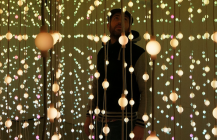
I recently found this photo and it got me thinking about the situation of installing Digital Art. I mentioned Discontinuum in an earlier post about the background of Ocean of light, things moved so fast since then that some times interesting Ideas get left behind or on the kerb. Its definately a concept worth revisiting.
This particular Installation was an odd experience, setting up a digital art work in a catholic church in Engien les Bains in Paris, where Amelie was supposedly set. After you have left these locations sometimes you forget all the time spent with your head buried in code or working out the logistics in the strangest of locations. The installation invoked a lot which i wasn’t expecting. We’ve set up a ton of these things but for some reason setting up in a church changed the landscape somewhat despite our tendency to remain objective about our work. It was a digital Art festival called Bain Numerique, 2009, more about it on the squidsoup blog. Discontiuum as an interactive piece is quite straightforward, your image is taken and played back to you fragmented over time and space through the physicality of the LED grid, the location in this instance did distort the project. Not a big fan of churches, and our presence there seemed to get a mixed reaction. Most people, in general, were intrigued, but a few found our presence bit challenging which at times left me feeling a little at a loose end attempting to justify in French what we were doing, when I can hardly find the words to justify any of this in English. We found ourselves asking questions that we rarely ask, as they are not so relevant to our process. This resulted in taking a more figurative/narrative route by including recognisable imagery from the stained glass within the church. It helped this potentially invasive technological instrument seem more compliant to its traditional and visually established environment.
As usual we had other things to think about, we also had to set up a trio of ghosts using the French character set. After a load of baguettes, some loss of patience and a bit of over priced beer, we got it all ready in time for the show. It was all such a whirlwind I had almost forgotton about it all until more recenly browsing through iPhoto. When the event happened ite surprised us how many people were there. This was mainly due to the antics of body>data>space that led a gathering through out most of the exhibits across Engien and generally contributed to the overall madness.
Here is the video Ant put together for Discontinuum:
Discontinuum derived from on of our experiments from the previous year when we had spent an intensive weekend in the foyer of the TechnoPark in Zurich with the sole purpose of seeing what visual, spacial and aesthetic qualities we could achieve with the Baby Nova. One of the routes we took, that we were keen to explore further, was reconfiguring a realtime image from a webcam into the cubes space, where I created a virtual representation of the cube and from it’s 3d images mapped the pixel colours of the realtime image to the locations of the LEDs. I wasn’t t really sure what to call this process, but it was suggested that the image was being projected onto the cube, which is kind of true in a virtual and conceptual sense, but considering each LED “projects” it’s own light outwards rather than being projected upon this is an interesting paradox. A kind of virtual/real space inverse projection. Considering all the work we had done with interactive virtual 3d and stereoscopic projections to this point, it certainly felt like we were moving in the right direction.
in this particular installation we took still imagery from the church, mainly the amazing stain glass windows and intermittently inverse projected them from various angles stopping at the angle where the camera input originated.
Ghost Out-takes are some old Director 3d lingo “mess ups”. The great thing about 3d work, especially when you are generating the model in code is that things don’t always go as planned. and down that road where things are not going as planned, if you push a little further you can come across some interesting things. With ghosts , a squidsoup project, this happened in a big way. We started building ghosts back in 2002 as part of a clarks digital bursary in the WaterShed in Bristol. It was a fun few days and the project that came out of it has been modified, changed and exhibited in different languages many times since, to a point where more recently I am thinking about making an iPad version, but thats another post. However every time I come back to look at ghosts I always find these screen grabs of “sculptures” that were made during the dev process when we were manipulating formula into the shapes that make the ghosts underlying structures.
Because Digital 3d Form is based on a very determined set of mathematical principles, experimenting visually with this “material” often leads down the same route of a kind of “ordered chaos” This ordered chaos, I think reflects very well on the human understanding of digital, in that everything we do or use we do not fully understand, we depend on structures and digital ecosystems that have been put in place for out use. Much like the real world :0) so thats why I love these pics, and am glad I kept hold of them.
Last year I was playing around with AS3DMod. Its a fantastic set of libraries that help you add deformation onto 3d forms within actionscript. You can read more about it here http://www.everydayflash.com/blog/index.php/2008/09/03/as3dmod/.
I was very excited by it and tried to find ways to include it into the projects that I was working on at the time. I controlled its parameters with tweenMax to create a flying, bendy postcard effect for goahead.co.uk Its is something that I wanted to do more with, possibly converting it to unity to see how it would fare on the iPhone , recently I was reminded of it when making updates to the go ahead! website for their new a Race for Life promotion.
1.
2.
3.
4.
I also played with As3DMod some more when I had an opportunity to recreate a book, “page flip”, turning effect that I had created a couple of years prior to enable us to make ebrochures. It seemed perfect to use As3DMod with away 3d to create a flexible page turning engine. The Mccoy’s website required a book section called “the man guide“. While the content for the man guide became more bespoke through its design process, it became next to impossible to create a CMS as with my previous page flip “template”. Nonetheless it still works with different sized movie clips as individual pages and consists of a default class to handle pages that can be extended for more bespoke pages such as the contents page etc.
During kinetica, staring at the Ocean of Light grid all day kind of makes your eyes go funny. Shaking the iPhone in front of it for over exposed images give a pretty good idea of how your eyes feel by the end of a day with the grid.
I uploaded a bunch of photos doing this here
A useful tool created by Richard at available on codebyfire.com
It nicely demonstrates how you can air can be used to create some useful applications that are quick and easy to install, update and to use. If you need to out put a lot of screenhots of the same size then this is really useful.
Here are some of the “sketches” we made during development of surface on the Ocean of Light Grid. We can address each light voxel individually the trick has been looking at the various way that we can render to the grid, and beyond that what is rendering to a real space grid of 3d Voxels that you can enter.
This week I am off to London to set up Ocean Of light (a squidsoup project) for the Kinetica Art fair. We has been developing this project for over a year and have been playing with this type of media (individually controlled LEDs in space) for over a couple of years.
So where does Ocean of Light come from? Through an experimental and playful approach to creating interactive digital installations, we often found ourselves exploring where real and virtual space coexist. We had explored this through multiuser activity and shared experience of audio and visual virtual space (altzero, ghosts), then entering physical space, perceptually through stereoscopy and physically with wearable proximity sensors (come closer) also using stereoscopic cameras to analyze physical movement to navigate virtual space (driftnet,freq2).
Each project led to their own discoveries but until we started working with LEDs in space it seemed like we were making experiences and environments that a user peers into through some kind of portal, or the screen space. Working with the Nova grid (Stealth, Discontinuum) certainly took a leap out of screen space and into the real world in a more determined way. However the close proximity of the LEDs still created a screen like situation as the viewer would be forced to view the work from an external proximity.
The Ocean of Light Grid is part of the evolution of this development process, Designed on the back of all this investigation and experimentation by squidsoup Ocean of Light should enable audio/visual environments to be experienced from within.
Surface is the first artwork to be exhibited using the Ocean of Light hardware. It uses minimal visuals and sound to evoke the essence of character and movement. Autonomous entities engage in a playful dance, negotiating the material properties of a fluid surface.
I found this to be a very time saving practice. Preloading content, listening for completion of loading often seems like a waste of time. I develop actionscript 3.0 in flashDevelop (which is undisputedly awesome). Any way I prefer to just get going with the fun stuff when programming AS3, moving things around making them “feel” nice but more often that not you have to load things in, set up some listeners and as great as the Loader Class is these days its still interrupts your flow. Embedding assets into your classes really helps speed things up. I had seen it many times in the past but never understood it to use it, but it is incredibly simple.
this is an example for away 3D. the collada file colladafile.dae is targeted in reference to the location of the scr folder. You can use this same process for a bunch of 3ds files or .Md2 files (quake character files which i will post about later) and use away3d can just parse them. hey presto no load events and instant access to your assets.
The main focus is
[Embed (source="../bin/colladafile.dae", mimeType="application/octet-stream")] public static const DAEFILE:Class;
and
model = Collada.parse(DAEFILE,{ texturePath:"", material:mat, autoLoadTextures:false, scaling:0.1,y:0,x:0, z:0});
view.scene.addChild(model );
publicfunction start3D():void{ //instantly makes a reference to the model… no loading //a quick color to go on it var mat:ColorMaterial = new ColorMaterial(0xff0000); //make the model from the embeded asset and add to scene
model = Collada.parse(DAEFILE,{ texturePath:"", material:mat, autoLoadTextures:false, scaling:0.1,y:0,x:0, z:0});
view.scene.addChild(model ); //set camera
view.camera.position = new Number3D(0,0,100);
view.camera.lookAt(model.position); //and go addEventListener(Event.ENTER_FRAME, runMe);
}
privatefunction runMe(e:Event):void { //to show it moving some what
model.rotationY += 1;
model.rotationX += 1;
view.render(); } } }
Hula hoops website supporting “the Hoopathon” organized by hula hoops for sports relief
We updated HulaHoops.com live last week. United Biscuits has been one of our major clients at Inbox for a while. And I think the designers at Inbox have been doing a great job working with their brands. As the programmer I am fairly pleased with hulahoops.com. Often While building these sites I do feel that the element of creative programming is served as an after thought, and this is something I am trying to improve at Inbox. This kind of media is very young still and its hard walking the line between preconceptions originating from print or TV advertising into web media. www.hulahoops.com
It was compiled for flash 10 and uses elements of away3D although not as much as origionally intended, such is the way a projects spec can change over the course of its manufacture. The hoops are a very nicely rendered sprite set generally thrown around with some TweenMax action.
Its been a while since Frog box was updated, it has been on my list for a while. Hal did a great job making a room for santa and we pulled some of those assets into frogbox for this release. The major update being that all there are lots of moveable objects. This is really a testament to how well unity is progressing as a software, this would not have been possible with previous versions. I am used to seeing technological progression aid performance being that I have spent most of my dev career building for the web and as the computers gained more power you also gain more dev options. What’s great about unity is the device (iPhone) hasn’t changed but the performance has.
Any way aside from all that Frog box is just a bit of fun and its free, so download it and chuck a frog about a bit … and for a limited time chuck Santa about a bit too.
Social Media